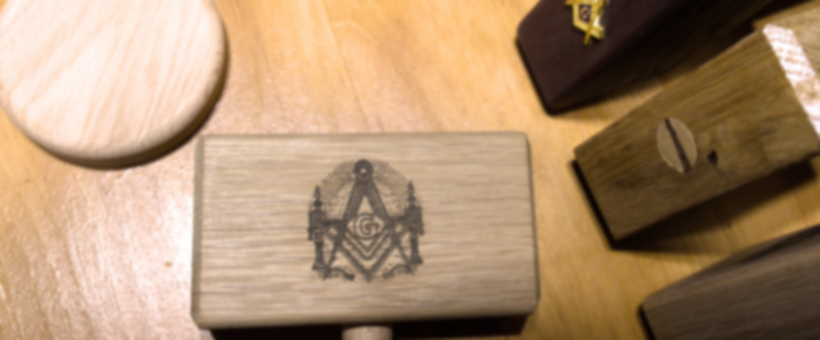
A gavel is a small wooden hammer, or mallet, used to call for attention and order. Whoever is presiding strikes it against a matching wooden base — a sound block — to make a sharp, carrying rap that cuts through a room. It is one of the few tools whose entire job is a single, decisive knock.
The parts of a gavel
- The head
- The turned wooden mallet, usually barrel- or cylinder-shaped, that delivers the strike.
- The handle
- Turned for balance so the gavel feels right in the hand and strikes cleanly.
- The sound block
- The round or square base the gavel is struck on. It protects the desk and gives the knock its clean tone — turned from the same board so the two ring together.
Who uses a gavel?
Judges
As a symbol of authority and to call a court to order.
Auctioneers
The strike that closes a sale: “going once, going twice… sold!”
Presiding officers
Chairs of meetings, boards, councils, and legislatures use it to open, order, and adjourn.
Masonic lodges
The Worshipful Master uses a gavel to open and close the lodge; it also carries symbolic meaning in Freemasonry.
A working tool — and a keepsake
A gavel plays two roles. As a working tool it keeps order in a real room. As a keepsake or award, an engraved gavel marks a milestone — an outgoing lodge Master, a new judge, a long career, a graduation, a corporate chair handover. Because a gavel stands for fairness, decisions, and the start and close of something important, it makes a gift that is remembered.
A short history
The gavel has long been associated with order and authority in assemblies, courts, and fraternal orders. Its most familiar modern forms come from parliamentary practice and the courtroom, where the strike signals that a decision has been made or that proceedings will begin or end. The same simple idea — one clear knock that everyone hears — is why it still appears wherever a group is brought to order.
How ours are made
We turn each gavel by hand from select Canadian hardwoods — red oak, white oak, black walnut, and maple — and finish it with a hand-rubbed hardwax oil, solid wood from start to finish. See how we make a gavel →
Frequently asked questions
- What is a gavel used for?
- A gavel is struck against a sound block to call a room to order, mark a decision, or signal the start and end of a session. Judges use it in court, auctioneers use it to close a sale, and the presiding officer of a meeting, board, legislature, or Masonic lodge uses it to keep order.
- What is the block a gavel hits called?
- It is called a sound block (sometimes a striking block or sounding block). Striking the gavel on the block — rather than on a desk — protects the surface and produces a clean, carrying knock. A matched gavel and sound block are turned from the same wood so they ring together.
- Do judges really use gavels?
- In many courts a gavel is a recognized symbol of judicial authority, though day-to-day use varies by country and courtroom — some judges keep one mainly as a ceremonial or desk piece. As a gift to mark a new appointment or a retirement from the bench, an engraved gavel is always meaningful.
- Why do Masonic lodges use a gavel?
- The Worshipful Master of a Masonic lodge uses a gavel to open and close the lodge and to call for order. In Masonic symbolism the common gavel also represents the work of shaping rough stone into smooth — so a gavel is a fitting keepsake for an outgoing Master at the end of his year.
- What is the best wood for a gavel?
- Dense hardwoods make the best gavels because they are durable and ring cleanly on the block. We work in Canadian hardwoods: red oak (strong, stained to highlight its classic grain), white oak (dense and modern), black walnut (deep, rich, classic), and maple (pale, bright, and crisp on the block). The right one is mostly a matter of the look you want.
- Can a gavel be engraved?
- Yes. We engrave a wooden plaque with a name, date, role, lodge number, school, company, or a short dedication, and can letter or carve a crest or emblem if you supply the artwork. The gavel head itself can also be marked on request. Engraved sets are made to order through our commission process.